Thursday, November 17, 2011

Advent

These excerpts are from a book on Festivals:

"The movement of the sun and the stars in relation to the earth determine the course of the Christian year, but each of its festivals reveals part of the content of Christianity. the year begins just before the natural turning point of midwinter. It starts quietly with a season of preparation, of waiting, of listening for what is to come. It begins, like the day, with a quiet period of twilight in which the sky grows brighter and the early light gradually seeps through the grey of night, until the dusk is at last filled within the mighty glow of the sun's rising. Advent is the twilight which comes before the sunrise of Christmas. the mood of this time is quiet contemplation. the great truth of Christ's coming will be the theme of Christmas. it can be taken up in thought and pondered in the heart during the four weeks of preparation. The sense of expectancy increases as the thought deepen. the mood of anticipation gives the season its special character...."

One of the things that help in this is the actual house preparation, with more time indoors, we are having laundry better folded, the tidiness shows glowing in the living areas and the bedrooms are finally at peace. Also the starting of decorations, with lights around, pictures of the Mother and Child, the advent wreath, the tree without yet ornaments, the laying of the scenery for the manger scene, everything beautiful to hint at  Christmas. The Advent spiral is also a traditional custom that exemplifies this silent, quiet, reverent walk to the center that lies ahead.


The Light of the Spirit in the House of the Body


"This season is one of struggle and its tranquility will often have to be won in face of disturbance. All the hindrances arise that could make hard and difficult the coming of Christmas as a spiritual event. Foremost among them is the commercial Christmas of the present day, drawing the interest of people to outer things, filling the quiet with material distractions.....This is not however the only kind of hindrance. Struggles between people, disturbances in destiny, often occur just in these weeks, which are rarely uneventful in ordinary life. the forces against quiet and peace of mind are out to shatter the true mood of Advnent. Strength of will is needed to renew tranquility again and again, from within, against discouragement. Advent is not to be experienced without effort."

Every year, at this time, conflicts start to abound in my life, outer and inner conflicts, and I like to remind myself that this shall too pass, and that I need to show endurance in the face of upheavals, a willful yet soft endurance, like the whisper of a humming sound under a storm.

During our months of Spanish rhymes and verses I have been  using the material from Tamara Chubarovsky, a speech therapist from Spain, now though I start to use my own, and for this season we will include K , P, N, sounds for the working of dwarfs beneath the soil:

Click, clock, click, clock,
los enanitos van picando.
Click, clock, click, clock,
piedras preciosas bajo el manto.


Thursday, November 10, 2011

Saint Martin

Following this trend of relationships and the true bride, we have stumbled upon the story "East of the Sun and West of the Moon".http://www.mythfolklore.net/andrewlang/323.htm

It is for me such an analogy of the relationship with our spouse, and how when falling in love we "see" the real person, their higher self, their true being, yet this vision fades away with time and it is a struggle to both recapture it and mantain it, just like the true Princess struggle through the journey. We start then complaining about our spouse, seeing the weaknesses instead of their virtues and pretty soon we are tearing the whole building down. Proverbs 14:1 Every wise woman buildeth her house: but the foolish plucketh it down with her hands.


It is through this vision of the higher self that also our own redemption is linked, as long as we still see the best of our spouse, there will be the impulse for them to become like that and the same for us. But many times we are paralized to do the change that is necessary in us in order to "see" again. Fear and pride stand in our way, we may feel that we are right and the spouse is wrong, or that we do not have the courage to change what is an habit. It is here that Christ again brings the possibility for us to leap with faith, and embrace that first vision with a strong grasp.

Around Martinmas times also the darkness is stronger, and for the same reason the light in us is prompted to shine brighter, this is the story of the young Martin, who then became Saint Martin:


How Saint Martin got his name: ( Catalan version)

Martin's father was a brave soldier from Hungary, under the commandment of the Roman Emperor, he traveled a lot and when his wife was pregnant and ready to give birth, she called him to come back home. The baby was born and everone was very happy, it was boy. The father, who was pagan brought him to the Altar of Mars and with the sword he made three movements around the baby, saying Martin, Martin, Martin, which mean little Mars.

The father was sent to Italy and the wife begged him to come along, -How come your son will learn to be a good soldier if he is not around you?. The father acquiesced and all the family moved to Italy where Martin grew up to be a good boy, he inherited the courage from his father and the good heart from his mother, he would usually defend animals and small children from unjustice.

Once Martin saw three boys who were torturing frogs in the bank river, they were tyeing with rope the legs and then left them in the water to see them struggling, Martin cryed: -What are you doing? the boys were ready to put the ropes on him too, and as the biggest boy got closer with the ropes Martin stampeded againt him and threw him in the water; while the remaining boys were helping their friend out of the river, Martin got the ropes of the frogs loose and softly, tenderly put them in the water again.

At 12 years old, tha father one day told the family about a new religion that was sprouting in the area, they were called Christians, they had the sign of a fish to mark their doorposts and some of them were refusing to be soldiers, they said that they were called to be all brothers. Martin went to the house in the village which the Christians use as meeting place and he listened to the songs. One day an older man and a youth came to the door and saw Martin, the youth invited him in and that is how Marin got to know the Christians for the first time. They told them the story about their master, how he had died on the cross and how he had resurrected, and that now it was possible for all to see him, and that they were all called to brotherly love.

Martin could not talk about these things at home, but he listened to the Christians speaking and his heart grew warm for their people.

At 15 yearslold Saint Martin was appointed to a teacher, to learn the art of soldiers, bow and arrow, jabaline, horse-riding, etc... and he was sent to the borders, to fight against the Germans. He served diligently the army for some years but eventhough he had lost contact with the Christians, his heart was empty with this job and longed for something.

One year Martin was at the border between France and Germany, it was the time to receive new clothes for the army especially those in good ranks. Martin got a new big coat, all lined with sheepskin and it was so long that it covered part of his horse as well. By November, one of the coldest nights he was travelling to Amiens, the icy winds were swirling any leaves that were left, it was so cold that even the ravens did not dare to fly, when all of a sudden, in front of him, Martin saw a man half naked, behind a rock that scarcely protected him from the winds. Saint Martin got closer, he took his sword and cut his coat in two, giving half of it to the beggar.

That night, when in deep sleeping  Martin had a dream, and he heard someone calling his voice, Martin, Martin! he saw two angels clothed with light bringing the half of the coat that he had given the beggar, and behind them the figure of the beggar, shining with light and with a radiant look in his eyes, he was saying: -Martin, you have clothed me while my body was naked, you have done this to me, as the least of your brothers, come and receive my peace.

Friday, November 4, 2011

Cambric shirt

We are getting ready for this afternoon gardenining work, we will stir cow manure that has been composted in humus, in rain water for one hour, sing songs and then go around town spraying in the yards and gardens for nourishment in the winter planting.

One of the songs that we will sing is a famous one from England, Scarborough Fair, and it reminds me of the continuous work that we do in life, in relationships, to see the best in every person. I am reading a book on The Meaning of Love by Soloviev and there are many quotes from the texts that are describing this striving:

"I can only acknowledge the absolute significance of a given person, or believe in him (without which true love is impossible), by affirmation of oneself in th sphere of the absolute, by affirming him in God, and consequently by belief in God himself, and in myself, as possessing in God the center and root of my own existence. This triune faith is already a certain internal act, and by this act is laid the first basis of a true union of the man with his other and the restoration in it (or in them) of the image of God......
But in order for the faith to be a living faith, it must set itself steadfastly against that existing society where meaningless chance builds its dominion upon the play of animal passions and, still worse, human passions. Against these hostile powers, believing faith has only one defensive weapon-endurance to the end. Te earn its bliss, it must take up its cross. In our materialistic society it is impossible to preserve true love, unless we understand and accept it as a moral achievement. Not without reason does the Orthodox Church in her  marriage ceremony make mention of holy martyrs and compare their crowns to the bridal crowns.
Religious faith and moral achievement safeguard an individual human and his love from being engulfed by materialistic society dyring this lifetime, but they do not give a triumph over death....An individual can really be saved, i.e, can regenerate and immortalize his individual life in true love, only conjointly or together with others."

This ties also with the lecture of the Gospel for this week, Reveltaions 3, 1-6, where John talks to the Church of Sardis, as they are asleep, yet some of them are worthy and will be clothed with the white garment. As we ponder on these thoughts and carry the work for the Earth, we bring this verse:

Let us but rightly, oh Spirit of Worlds,
Be penetrated
By spirit-grasping aspiration,
that we won't miss
That, what can be done for the good of the Earth
And for the progress of the Earth.
to wrest from Pride and Fear,
in the right sense.

Thursday, October 27, 2011

La Castanyera (The Chestnut Lady)

In my country of origin we do not have Halloween, but we have la Castanyada, a festival with roasted chestnuts, baked sweet potatoes and panellets. It is also very special time of the year as the colors are still in the tress but fading on the ground, and the winter peeks its nose through the clouds. The day after is All Saints, and the families gather together, to remember the love ones that have passed away.


This is a story of that time of the year, situated in Barcelona, around 1960:


The Chestnut Lady(La Castanyera)

Once upon a time there was a boy that lived with his family in the older part of town, where old castles and turrets where seen through the more recent buildings, and where alleys and crooked streets made the walking every day a small adventure. Each Saturday morning him and his father went together to get the newspaper from the newstand, a dozen of blocks away from home, and they spent that time talking about the past week, and the week ahead.

It came to pass that the fall season was coming once again, (it was the ninth one for the boy), and the streets got darker in the morning, with leaves from the maples trees whirling all around and making deep carpets to walk through. At that time of the year, the Chestnut Lady (Castanyera) also made her appearance, she was an old lady with hooded cape and cloaks that would stand in the corner of Santa Maria Street and the Pi Square, with her small fire burning in front of her, with an iron low pot, roasting chestnuts and sweet potatoes for the passers-by. Here and there a person would come and she would prepare a little cone with old newspaper and rake some chestnuts from the grill on top of the pot, and slide them carefully inside the newspaper cone, then she would fold the upper part and hand the nice warm bundle of chesnuts to the client.

The boy and father had to pass her on their way to the newstand, and the boy, asked his father What is the name of the Chestnut Lady? I do not know, said his father, and they went along. The next Saturday, again in passing the Chestnut Lady, the boy asked his father: Where does she live? I do not know, answered his father. On the third Sunday approaching the end of October, again the boy asked: Does she have family? I do not know, said his father.

One block further, the father stopped to talk with an acquaintance of him for a few minutes, they were talking about some business and the weather for the week. After bidding farewell to each other, the father suddenly realized that the boy was not by his side. He looked and called around and around, turning to every corner, and looking into every spot where the boy may be lost. It lasted for one hour, and the father, in despair, turned his steps back home to look for help. But, when passing by the Chestnut Lady, he suddenly stopped, and for some reason, instead of asking about his lost boy, he asked about her name, the name of the Chestnut lady, which was Esperansa, and he still spared some time asking where did she live, even he inquired about her family and relatives in town. Immediately after that last question was answered, the face of the boy appeared through the corner of the Pi Square, and father run to embrace him and held him in his arms.

 After that day, they always stopped at the corner of Santa Maria street and Pi square, to talk with the Chestnut Lady and have some time with her.

(Soon we will do some drawings for the story, edit it and make a small book for children.)

Below there is a recipe for the "panellets". We usually put way less sugar in the mix, or substitute with honey, and we use almond flour instead of grinding the almonds ourselves. Also we do mix the same amount of coconut into the dough for the coconut type.

Prep Time: 8 hours, 45 minutes

Cook Time: 4 minutes

Total Time: 8 hours, 49 minutes

Ingredients:

  • 1 lb. ground almonds
  • 2 1/2 cups granulated sugar
  • 1/2 -1 cup water
  • 1 small potato
  • gtrated peel of 1 lemon
  • 3-4 drops lemon juice
  • Toppings:
  • pine nuts
  • sweetened cocoa powder
  • candied fruit
  • Flavorings:
  • instant coffee powder
  • coconut flakes

Preparation:

Makes approximately 32 cookies.
Blanch almonds, then grind in food processor until almonds are a fine dust.
Peel the potato and cut into quarters. Boil potato in a saucepan until cooked. Drain water and mash with a fork.
Place sugar in a medium saucepan. Pour 1/2 cup water into the pan and stir to dissolve sugar. Add more water to completely dissolve sugar if necessary. Place on medium heat on stovetop and bring to a boil, stirring often. Add 3-4 drops of lemon juice. Reduce heat and simmer until mixture is a thick syrup.
Remove saucepan from heat. Using a large wooden spoon, gradually stir in ground almonds, potato and grated lemon peel. Allow to cool to room temperature. Then, refrigerate overnight.
Pre-heat oven to 380F degrees. Grease cookie sheets. Spoon out dough with a teaspoon. Roll dough into small balls in your palms. Then roll the balls in powdered cocoa or pine nuts. If using pine nuts, brush each with a bit of egg white. Place on greased cookie sheet.
If you want to flavor the cookies, separate a portion of the dough and with your hands, work in a bit of instant coffee flakes, candied fruit or cinnamon. Then make individual balls.

Bake cookies just long enough to brown the pine nuts - about 4 minutes. Remove immediately using a spatula before cookies cool.

Thursday, September 29, 2011

Michael

I have been reading "What Men Live By" by Leo Toltsoy, during this week, and even though the portraying of Saint Michael in this story is not the usual one seen in these days, with sword and ready to fight the dragon, it is nonetheless very adequate for us. We could even for a moment pretend we are in his role, and learn the 3 truths that God has commanded him to search for:

-"Learn what dwells in man"
-"What is not given to man"
-"What men live by"


Both Simon the Shoemaker and Matryona his wife, start the encounter with Saint Michael with lower human traits, with selfishness, greed, fear, etc...but in the course of the story, these traits are overcomed by love. Matryona changes her foul thought into a loving gaze and Simon changes his mind and retraces back his steps to help him.

I have talked in the past about communities, how people striving to form a community may find it so difficult to sustain the effort, and it is because we are so separated from the spiritual world, that the differences amongst us are made unsurmountable. Some people may look for community for wrong reasons, egotistic intentions, or plainly self-interest. yet how can we humans strive for something better than that?

We find it in the first community, marriage, where two have to become one, and where the natural binding is again, plainly not enough, nowadays we have more independency from each other because we have more independency from the spiritual, but until we gain again the truths about reality, about the spiritual origin of all, and we consciously make the work to align super-naturally with these truths, all will fail, marriage, and  communities at large.

The quotes at the beginning of Leo Tolstoy's story are worth thinking:

We know that we have passed out of death into life, beacsue we love the brethren. He that love not abideth in death. I Epistle St John iii.14

Whoso hath the world's goods, and beholded his brother in need, and shutteth up his compassion from him, how doth the love of God abide in him? My little children, let us no love in word, neither with tongue; but in deed and truth. iii 17-18

Love is God;and every one that loveth is begotten of God, and knoweth God. He that loveth not knoweth not God; for God is love. iv 7-8

No man had beheld God at any time; if we love one another, God abideth in us. 1v 12

God is love;and he that abideth in love abideth in God, and God abideth in him. iv 16

If a man says, I love God, and hateth his brother, he is a liar; for he that loveth not his brother whom he hath seen, how can he love God whom he had not seen? iv 20

One of my teachers, the director of a school in Spain, told me once about her youthful longings to work in a community. As time went by, she confessed that just striving to hold a school smoothly in a way that everybody was heard and honored, was enough community for the time-being.

I have also the same longing, just striving to hold the family in loving relationships, to strive to "see" every person that I encounter and thus give them my attention, to be part of groups striving to do the same, to overcome our selfishness, and connect again with God so we can truly love one another, that maybe is enough community for the time-being.

May Michael protect us in that walk.

Thursday, September 22, 2011

Atentiveness

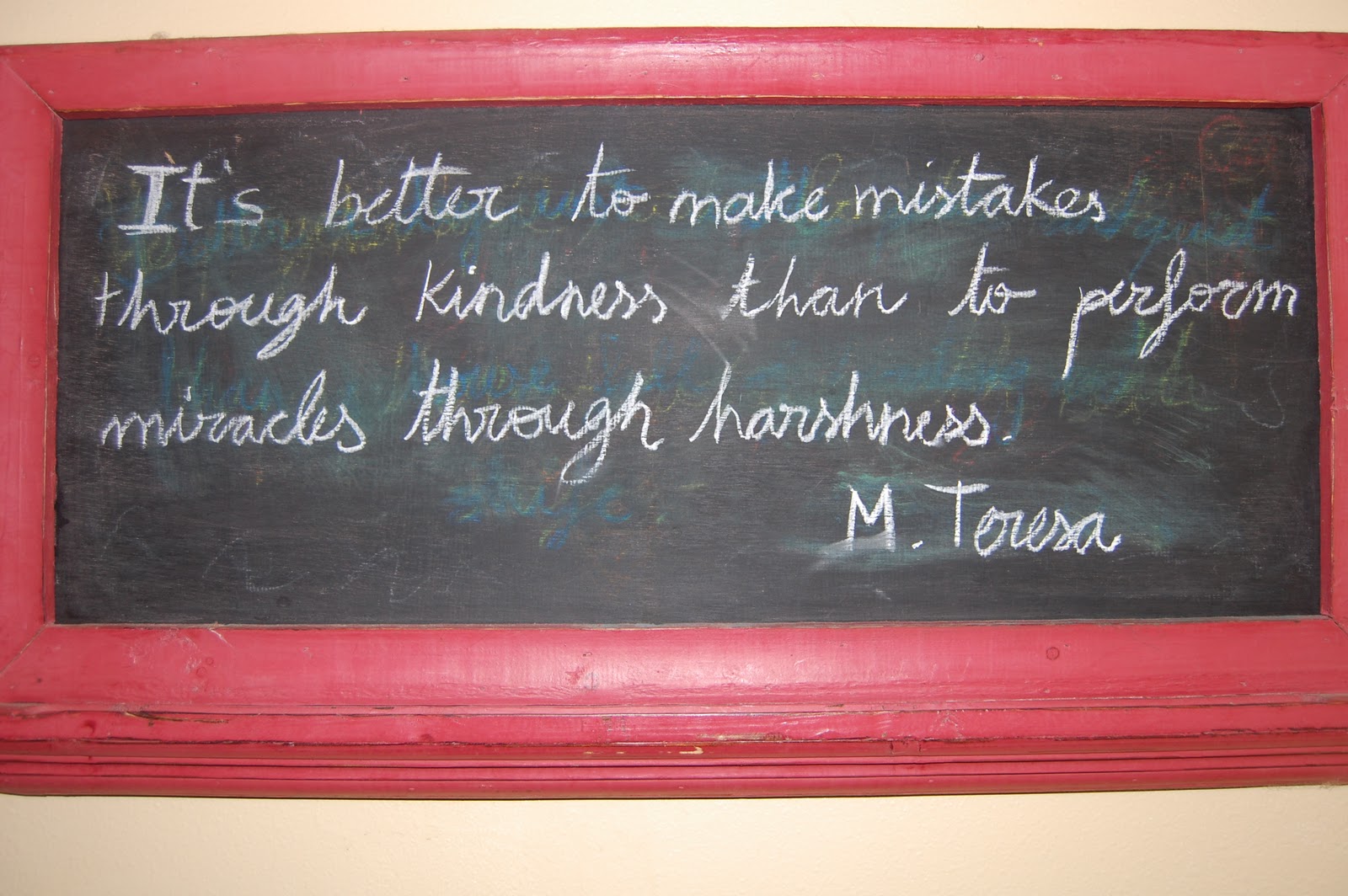
I have a quote of Mother Teresa in my kitchen blackboard and has stayed there for over two years now. Every time I would look at it I would think is time to change it, initially it was designed as a board that would have different quotes and mottos changing periodically; yet it did not happen. This quote seemed more adequate to any other thoughts, comments or sayings that have passed my way during all that time, that is until last week.


For me it is rather special because it stresses the importance of doing things out of love, and I may be caught here and there doing things fast and efficient, yet with no love, and I know this is the cause of much unhappiness around me. What is the point if the house is in order, the curriculum followed, the lessons done, the meals nutritious, the phone calls and conversations dealed with, if there is no love? Sometimes I need to catch myself reading the quote and remembering that is better to dine on onions and smiles that on roast beef and tears.

This also can be followed up to our mind, what are the thoughts behind every action, what is the real intention after every duty? When slowing down the true thoughts can come to light, and then we can deal with them, either accept our selfishness or ignorance, or change them for the better.

I have been asking for some time about love, how to love better, how to love beyond human love. And this is the quote that will replace the old one in my kitchen blackboard:

"Atentiveness is love"

I know there are many other higher wisdom writings to put, (God is love...) yet this one in its simpleness captures one pathway to love, atentiveness. To be attentive to the carrots when I am cutting them, to pay attention to the child when asks a question, to really listen to the husband when he says something, to be attentive with my whole heart to any situation.

I know some teachings of the east like yoga or alike train the mind through breath exercises and they do good out of these, because the mind is centered, yet the path that I am choosing goes searching for good in the opposite direction, in training the mind, the thought process, which in turn changes the breath via the heart. This is western, modern (compared to old eastern wisdom) and thus separated from the new age movement, it is the path of coming back to God through the earth, through Christ.

Thursday, September 1, 2011

Sympathy vs antipathy

We have been on vacation for a while, visting old friends and making new ones. It has been a delight yet we are also glad to be back and starting our homeschool year. Today was our first day and we accomplished much. We have set the forms of the homeschool day, the verses and songs for opening and closing, the fuctions of the space and also details like the weather chart, etc...

There is something special about starts and something special about friendships too, I think that sometimes we may be carried by the sweet beginnings of a relationship, and yet forget that in the older relationships new things can arise too if we are open to it.

I have found examples of this in this last trip where older friends had been moving in different paths of life and thus have less things in common between them, but as I listen closer, it does seems that a lot can be united where distance abides.

The same holds true for antipathy and sympathy, we may seem attracted to some kind of personalities, and get to befriend the same type of people, perhaps if we are of one temperament we feel inclined to like the opposite one, and vice-versa, but is is in overcoming this law of sympathy that we can exercise our full human freedom, in choosing to be friends to those that we might not feel inclined to, usually the ones that hold some likeness to us, that some truth about ourselves is discovered and yielded to the service of the highest. ( That is one of the benefit in having children that have the same temperament working together for a while, their temperaments soften up with each other's company)


I have been observing sunflowers for a while now, following the indications of observation exercises to get to know the essence of the plants, and I discovered that after a while, a relationship with the sunflowers arose, somehow the thoughts of sunflowers got intermingled with my daily life and at some point the picture came of the whole plantation, where the spaces in between them got brighter and intense, whereas the sunflowers themselves difused in the background.

 It is this kind of exercise that also helps us see through our human nature, and focus on the spirit that resides in us, thus vanishing anger, jealousy, hatred and other such like thoughts from our life.